There was a time when buying out-of-home advertising was relatively simple.
You wanted a billboard, you found the media owner, checked availability, agreed a price, supplied the artwork and booked the campaign.
Then digital out-of-home arrived. And with it, came a new vocabulary.
DSPs. SSPs. Ad exchanges. RTB. PMP. Programmatic guaranteed. Audience segments. Bid requests. Supply paths. APIs. Data partners. Verification.
The technology is impressive. The opportunity is promising.
But there is a question the industry should probably ask more often: Has programmatic DOOH actually made buying OOH simpler, or have we simply replaced one set of complexities with another?
DOOH is becoming too important for this question to be ignored. This is not an argument against programmatic DOOH. Far from it. Digital out-of-home is becoming one of the most important parts of the OOH market.
IAB UK says UK DOOH investment reached £964 million in 2025, accounting for 67% of total OOH advertising spend. It
now forecasts that DOOH could account for 76% of UK OOH spend by 2031.
That means the technology sitting underneath the market matters. If DOOH is going to become the dominant form of OOH, then the industry needs a buying infrastructure that makes the medium easier to plan, buy, measure and understand.
DOOH demand-side and supply-side platforms (DSPs and SSPs) were supposed to facilitate that. But so far, that’s not the case.
What exactly are DSPs and SSPs?
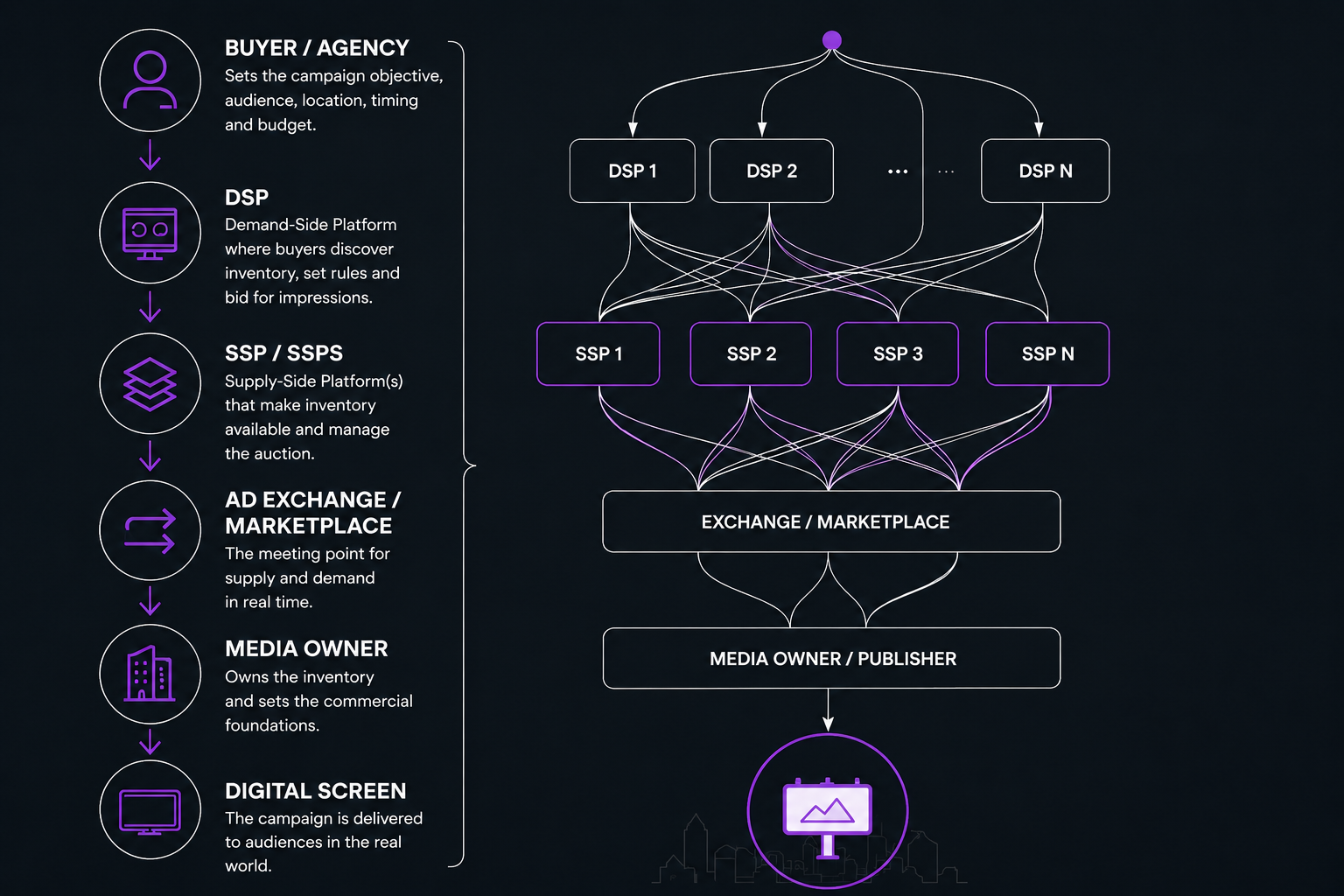
At a basic level, the model is straightforward. A Demand-Side Platform (DSP) is designed for the buyer. It allows an advertiser or agency to access available inventory, apply targeting and campaign parameters, bid on opportunities and manage the campaign.
A Supply-Side Platform (SSP) sits on the media-owner side. It helps operators make their digital inventory available to buyers and manage the commercial process around that inventory.
An exchange or marketplace can sit between them.
In theory, it is elegant.
The media owner makes inventory available.
The SSP distributes that inventory.
The DSP allows buyers to access it.
The buyer sets the rules.
The technology handles the transaction.
Everybody wins.
Except that the real ecosystem is considerably more complicated. The problem is not that there are DSPs and SSPs. Having multiple technology providers is not inherently a problem, and competition can be extremely healthy.
Different platforms can offer different strengths. One might be particularly strong on audience targeting. Another might have better international inventory. Another might integrate effectively with broader omnichannel campaigns. Another might have stronger media-owner connectivity.
The problem begins when the buyer has to understand the technology architecture before they can understand the media opportunity.
That feels backwards. A brand should be asking:
- Who do I want to reach?
- Where do I want to reach them?
- When do I want to reach them?
- How much do I want to spend?
- What outcome am I trying to achieve?
Instead, buyers end up asking:
- Which DSP should I use?
- Which SSP has the inventory?
- Is that inventory exclusive?
- Is it available through another SSP?
- Am I accessing the same screen through multiple routes?
- What data is being added?
- What supply path am I buying?
- What fees sit between the advertiser and the media owner?
That is not necessarily simplification. It is infrastructure complexity.
The irony of programmatic OOH
The original promise of programmatic advertising was automation.
IAB UK describes programmatic DOOH as using automation and data to support the planning, buying, targeting, selling, delivery and measurement of digital out-of-home campaigns.
That is a compelling proposition. Instead of manually selecting hundreds or thousands of individual screens, buyers can use audience, location, time, contextual and other data signals to determine where an impression should be bought.
That is genuinely useful.
The problem is that automation does not automatically equal simplicity for the user. A process can be automated while still being difficult to understand. And that distinction matters.
The buyer does not necessarily want more platforms
Imagine a buyer wants to run a £100,000 national DOOH campaign. They do not really want to spend their time comparing the architecture of five DSPs.
They want the system to answer a much simpler question: What is the best way of deploying £100,000 against my objectives?
If Platform A gives them access to 60% of the relevant inventory, Platform B gives them 70%, and Platform C gives them 65%, the existence of multiple platforms does not automatically create better buying.
It creates more work.
The buyer will need to understand what inventory overlaps.
They will need to compare CPMs calculated from different datasets.
They will need to reconcile reporting.
They will need to understand whether a screen is genuinely unique or is simply available as a duplicate through another route.
And they may need to figure out whether they are paying for additional technology without receiving additional media value.
That is where the industry needs to be careful.
And the media owner has a similar problem:
Imagine operating a network of digital screens.
You want to maximise occupancy and yield.
One platform offers access to a particular pool of buyers. Another offers a different pool. A third promises additional demand. A fourth provides access to international advertisers.
So you integrate them all.
Suddenly, the supposedly automated environment involves multiple technical integrations, different specifications, different commercial agreements, different reporting structures, different data requirements, different troubleshooting processes and different payment arrangements.
The SSP is supposed to make selling easier.
But if a media owner has to maintain multiple SSP relationships simply to achieve adequate market access, the technology can start creating operational complexity of its own.
That does not mean SSPs are unnecessary.
It means the industry needs to distinguish between technology that creates access and technology that creates duplication.
The supply path matters
This is one of the most important conversations the industry needs to have.
In digital advertising, supply-path optimisation has become vital because buyers want to understand how many intermediaries sit between them and the publisher.
The IAB Tech Lab’s SupplyChain framework is designed to give buyers greater visibility into the parties involved in selling an impression.
That principle is just as relevant to DOOH.
If the same digital screen can appear through several routes, buyers need to understand what they are actually buying.
Otherwise, the industry risks creating an ecosystem where the technology layer becomes more complicated than the media itself.
And that would be a strange outcome for a medium whose biggest selling point has traditionally been its simplicity.
OpenRTB was supposed to help
The industry is not ignoring this problem. In 2022, IAB Tech Lab formally integrated DOOH into OpenRTB, providing a common framework for programmatic trading.
That was a significant development.
OOH has unique characteristics that do not map perfectly onto conventional digital advertising. One display can be seen by multiple people. Audience measurement can be modelled. A screen exists in a physical location rather than inside a browser or app. Creative restrictions can vary between environments.
The OpenRTB DOOH work was intended to standardise how this inventory is described and traded.
That is exactly the right direction.
But standards do not automatically eliminate commercial fragmentation.
They simply make it easier for different pieces of technology to communicate.
The industry still has to decide how many layers it actually needs.
One screen, multiple routes
Suppose a media owner makes a screen available through several SSPs.
That can increase access to demand.
But from the buyer’s perspective, the same underlying media opportunity could potentially appear through different supply paths.
The question then becomes:
Is more access genuinely creating more value, or is it simply creating more paths to the same inventory?
That distinction matters because a buyer does not need five ways to purchase the same impression.
They need the most efficient way to purchase the right impression.
This is where supply-path optimisation could become increasingly important in programmatic DOOH.
The winning ecosystem should not necessarily be the one with the most platforms.
It should be the one that provides the cleanest path between genuine demand and genuine supply.
There is another issue: programmatic does not mean every OOH campaign should be programmatic. This is something the industry sometimes forgets.
Programmatic is a method of buying.
It is not a campaign objective.
If I want to dominate a particular road with a large-format billboard for four weeks, buying a guaranteed package directly may be completely logical.
If I want to reach commuters around a particular location when certain conditions occur, programmatic DOOH may be extremely powerful.
If I want to combine audience targeting, location, time and contextual triggers across a large digital network, programmatic can provide a level of flexibility that traditional booking cannot easily replicate.
The question should therefore not be: Should we buy OOH programmatically?
It should be: Which parts of this OOH campaign benefit from programmatic buying?
That is a much more useful question.
The DOOH ad technology should disappear into the background
The best technology is often the technology the user barely notices.
A buyer should be able to specify:
Budget: £50,000 Audience: Adults 25-54 Geography: Manchester Objective: Reach and frequency Timing: 7 days Environment: Commuter and retail Creative: Dynamic And then receive a useful answer.
Not a list of platforms.
Not a lesson in SSP architecture.
Not five different dashboards.
A media plan.
This is where OOH has an opportunity
The OOH industry has spent years trying to make itself more like digital advertising.
But perhaps the next stage is the opposite.
OOH should take the useful parts of digital ad tech while rejecting some of its unnecessary complexity.
Keep automation, audience targeting, real-time optimisation, dynamic creative, trigger-based buying, transparent reporting, measurement and flexible budgets.
But avoid creating a labyrinth of intermediaries simply because the technology allows it.
The objective should be less friction, not more technology.
What should happen next?
I think the industry needs to move towards five principles.
- Interoperability should be the default
Buyers should not need to rebuild their workflow around every individual platform.
Open standards such as OpenRTB are important because they create a common language between buyers and sellers.
But interoperability needs to exist at the practical level too.
- Supply paths should be transparent
Buyers should know who is involved in the transaction.
If there are multiple intermediaries, that should be visible.
If an SSP has a direct relationship with a media owner, that should be clear.
If inventory is being resold, buyers should be able to understand the route.
- Platforms should be judged by incremental value
The question should not be:
How much inventory do you have?
It should be:
What additional value do you provide?
More inventory is not necessarily better if another platform already provides access to it.
- Reporting needs to become comparable
The industry can automate buying incredibly quickly.
But if different platforms report campaigns differently, buyers are still left doing manual work at the end.
A £50,000 campaign should not require an analyst to spend days reconciling five different reporting environments.
- The buyer should not need to understand the plumbing
This may be the most important principle of all.
The technology should make OOH easier to buy.
Not make buyers become ad-tech specialists.
So, are there too many DSPs and SSPs?
Possibly.
But I think that is actually the wrong question.
The better question is:
Are there too many unnecessary paths between the buyer and the media owner?
There can be multiple excellent platforms without creating a problem.
Equally, one platform can create enormous complexity if it introduces unnecessary layers, opaque economics or duplicated inventory.
The number of platforms is not the KPI.
The friction created by those platforms is.
And as programmatic DOOH continues to grow, that distinction is going to become more important.
IAB UK’s latest forecast suggests that DOOH could represent 76% of UK OOH spend by 2031.
That is a huge market moving through a technology transformation.
The industry therefore has a choice.
We can build a programmatic ecosystem that looks more and more like the complicated parts of online advertising.
Or we can build something better.
A system where automation genuinely removes manual work.
Where buyers can access the market without needing to understand every piece of technology underneath it.
Where media owners can maximise yield without maintaining a maze of integrations.
And where the technology ultimately becomes invisible.
Because the real measure of a successful OOH buying platform should not be how sophisticated it looks.
It should be much simpler:
Did it make buying OOH easier?
If the answer is no, perhaps we have automated the wrong part of the problem.