Three acquisitions quietly rewired the entire OOH industry in under two years. Here’s who actually won, and why the biggest prize in the category still sits unclaimed.
If you compiled a list of OOH competitors even eighteen months ago, three of the names on it don’t exist anymore, not because they failed, but because they got bought. Hivestack disappeared into Perion. Vistar Media disappeared into T-Mobile. Place Exchange disappeared into Broadsign. Anyone still analyzing this market as nine independent companies is already reading an outdated map.
But the more interesting story isn’t who bought whom. It’s what none of them have bought yet.
The old moat in this industry was owning screens. The new moat is understanding them. And right now, not a single company in this space owns both at the same time.
First, the market isn’t shrinking. It’s exploding.
Global OOH hit $54.2B in 2025, forecast to reach $56.4B in 2026, roughly 5.1% of all global ad spend. DOOH alone is $25.5B, already 47% of the category and closing in on half. In the US specifically, OOH crossed a record $9.46B in 2025, with digital screens delivering 36.3% of that and growing more than 10% a year.
This isn’t a category anyone needs to defend. It’s a category everyone suddenly wants a bigger piece of, which is exactly why the acquisitions happened.
The three deals that quietly changed everything:
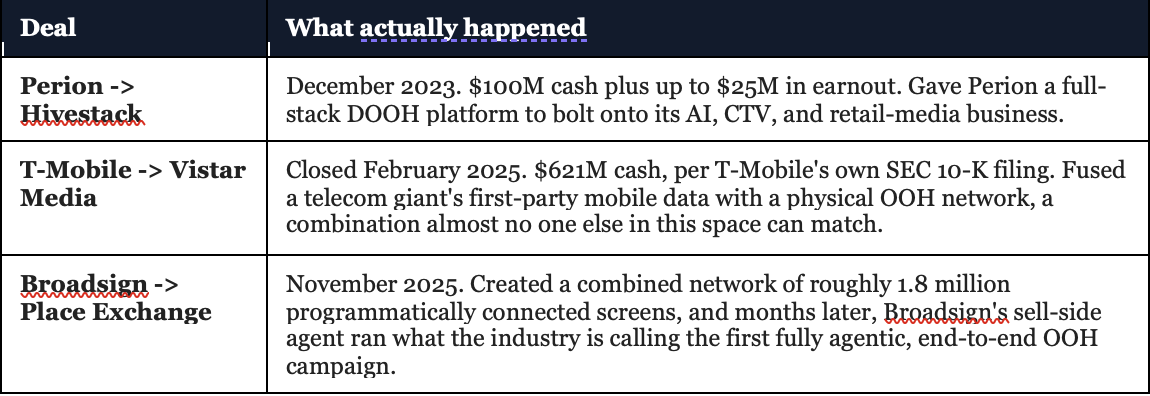 Every figure above is sourced directly from company press releases or SEC filings, not estimates.
Here’s where most analysis gets this wrong:
It’s tempting to rank these companies by revenue and call it a day. Don’t. The Trade Desk pulled in $2.9B in FY2025, but that’s omnichannel demand-side revenue, not OOH specifically. JCDecaux’s group reported EUR 3.967B, of which VIOOH’s programmatic revenue, EUR 180.5M, up 19.2%, is only a small slice. And Broadsign, AdQuick, and StackAdapt are private. They disclose nothing.
Rank this market by revenue alone and you’ll conclude Broadsign and AdQuick barely matter. That would be a mistake, and it’s exactly the mistake the next section is built to correct.
The competitive analysis nobody else is publishing:
Instead of one revenue number, score every company across the six things that actually decide who wins this category: demand-side reach, supply-side control, data depth, AI capability, measurement rigor, and OOH-specific depth, and a much more useful picture appears. Here’s the full board, scored 1 (weak) to 5 (strongest):
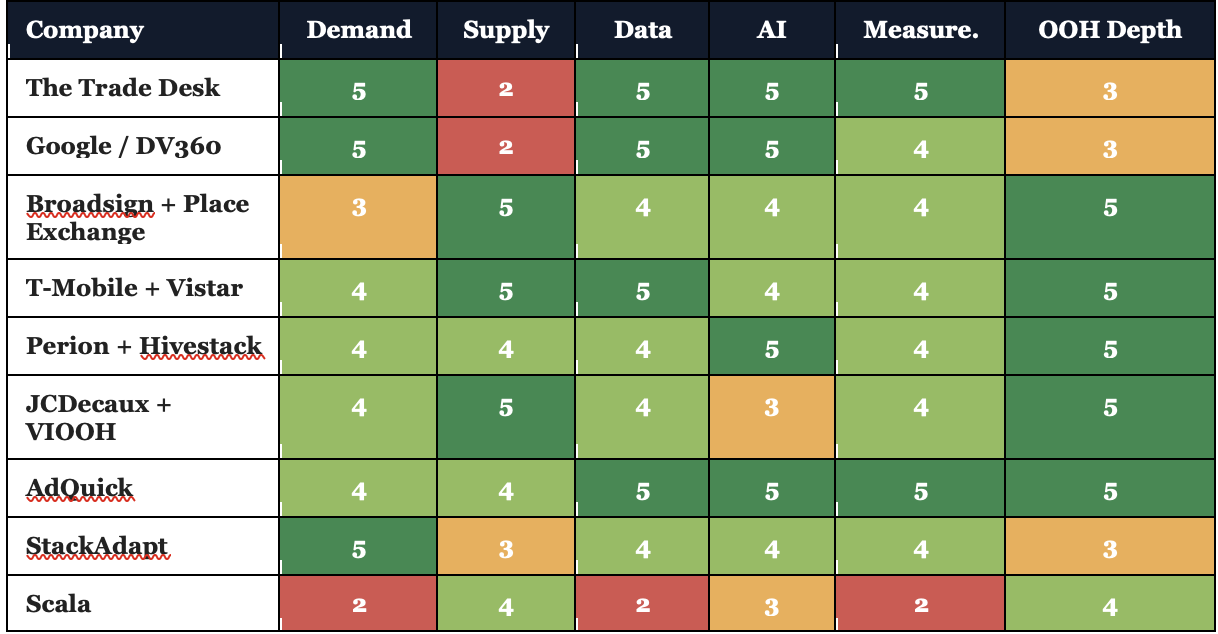 Scores reflect this analysis’s own qualitative benchmarking of each company’s public positioning, not an independently audited index. Two patterns jump out immediately: The Trade Desk and Google dominate demand, data, and AI but score weakest on Supply, since neither owns physical screens. Broadsign, T-Mobile/Vistar, Perion, and JCDecaux dominate Supply and OOH Depth but trail on raw Demand-side scale. AdQuick is the only company that scores a 5 across Data, AI, Measurement, and OOH Depth at once, without the Demand or Supply scale of the bigger ecosystems.
Five battlegrounds, not one market
Part of why “who’s winning OOH” is the wrong question is that OOH isn’t one fight, it’s five, and almost nobody shows up to all five at once.
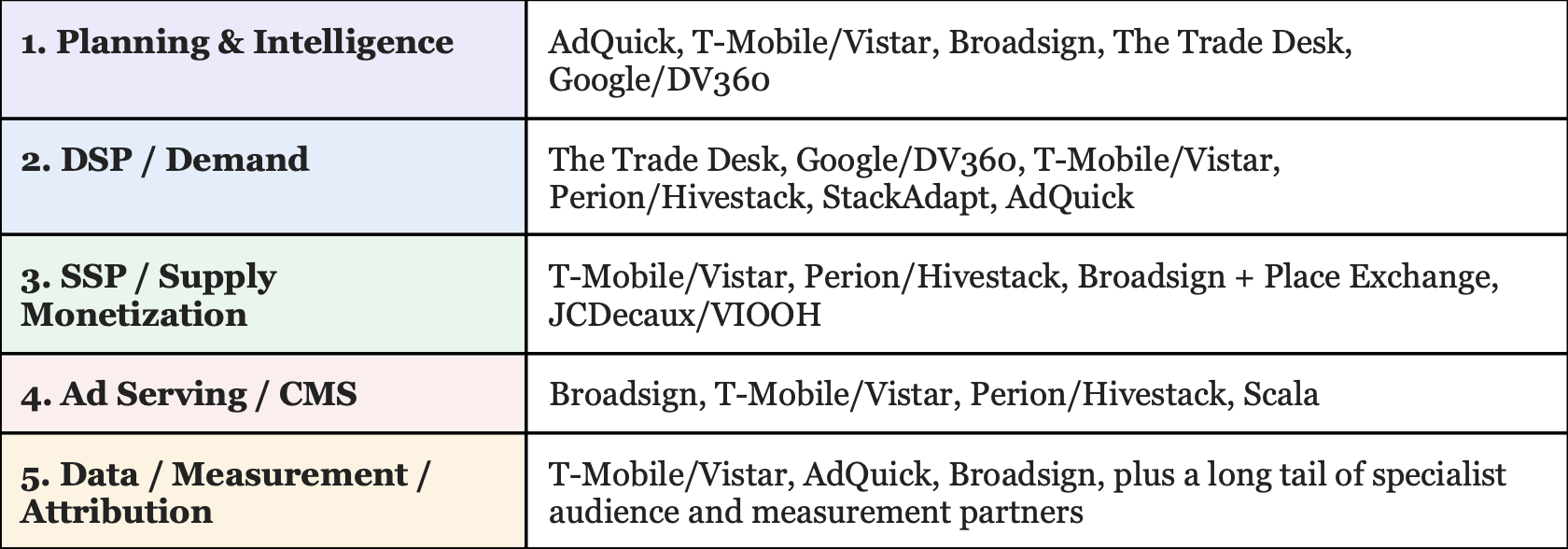
Notice how few names show up more than twice. That’s not an accident, it’s the entire consolidation story compressed into one table.
If you only remember one leaderboard, make it this one:
Based on everything above, here’s how this analysis would hand out the specialty titles, not overall “best,” just best at the thing each one actually does:
| Best DSP at scale | The Trade Desk |
| Best data ecosystem | Google / DV360 |
| Best OOH-native platform | AdQuick |
| Best SSP / supply infrastructure | Broadsign + Place Exchange |
| Best physical-world data play | T-Mobile / Vistar |
| Best AI-native platform | Perion / Hivestack |
| Best independent challenger | StackAdapt |
| Best premium DOOH supply | JCDecaux / VIOOH |
Here’s the full breakdown this section is drawn from, company by company:
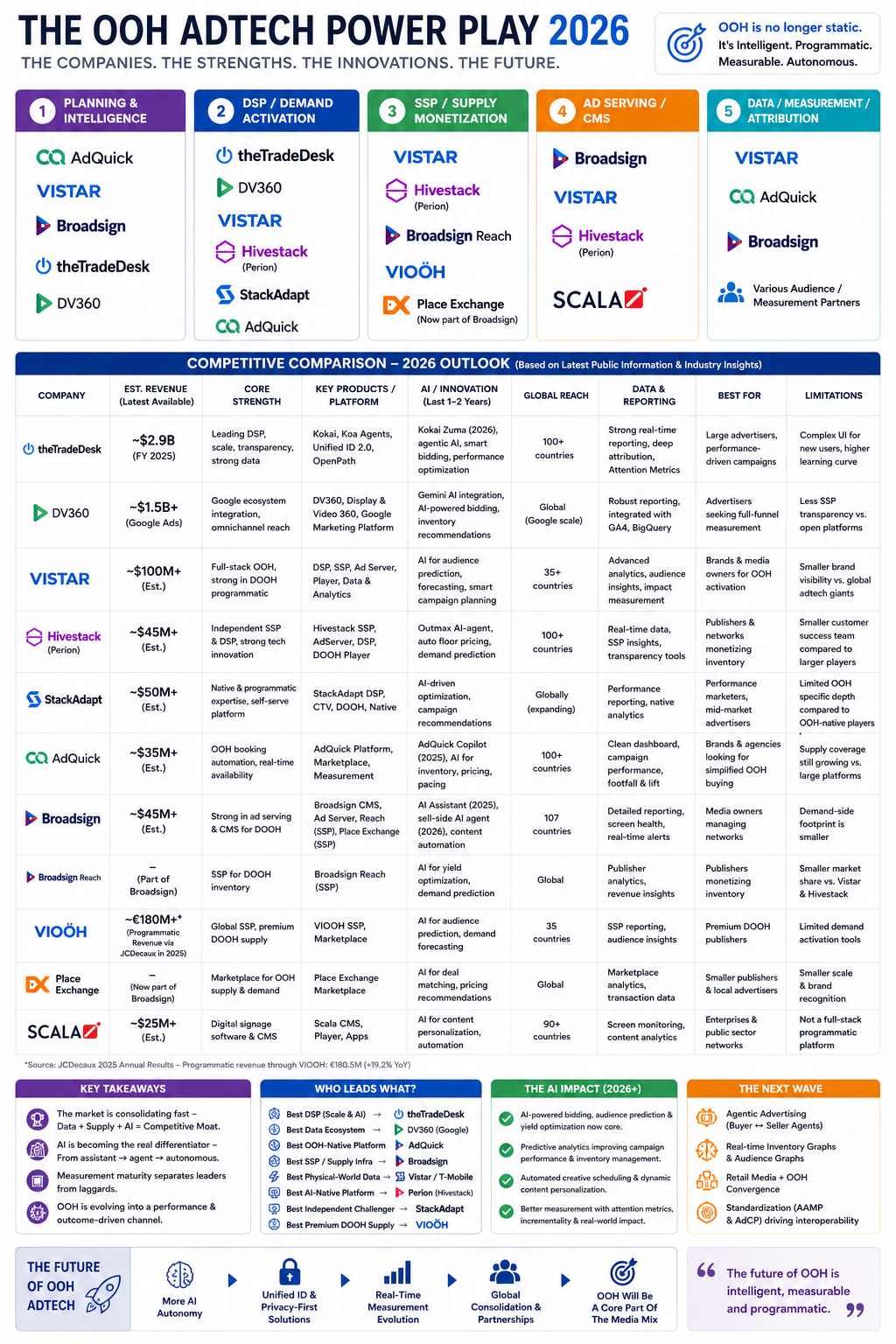
Source visual referenced for this section’s strategic-position mapping and leaderboard. Company-by-company revenue estimates shown in this graphic are marked as estimates by their original source and are not independently verified in this piece.
The real moat: a thought experiment:
Picture two companies. Company A controls 2 million screens. Company B controls 800,000, less than half as many, but knows exactly who sees each one, when, where they came from, where they’re headed, which screens overlap in audience, what each impression is actually worth, and which creative reliably drives a store visit.
Company B wins.
Physical inventory can increasingly be plugged into programmatic and agentic pipes no matter who owns it, which makes owning more screens progressively less defensible on its own. Intelligence can’t be bought off a shelf. It takes years of accumulated data on audiences, context, pricing, and outcomes that a competitor simply can’t fast-forward through.
 The one quadrant that stays empty across every company we mapped: maximum supply and maximum intelligence, at the same time. Nobody’s claimed it yet. That’s the single biggest opening in this entire industry.
Where the AI race actually stands:
Strip away the marketing language and there are really just six stages of AI maturity in this category: an assistant that helps you build a plan, a system that recommends what to do, one that optimizes a live campaign automatically, an agent that builds and executes the campaign, agent-to-agent negotiation, and full autonomy.
Most of the industry is clustered at stages three and four. Broadsign is the furthest along we found any public evidence for, its May 2026 agentic campaign with Draft Digital is the clearest real-world proof that stage five is no longer theoretical. Nobody has publicly and fully demonstrated full autonomy at scale. That gap is exactly why this market is still this exciting.
The next wave is already forming:
Four things are converging right now that will decide who’s still relevant in this table three years from now:
- Agentic advertising: buyer agents and seller agents negotiating and transacting with each other directly, the way Broadsign and Draft Digital already demonstrated.
- Real-time inventory and audience graphs: replacing static spreadsheets with a live, queryable map of every screen and who’s near it right now.
- Retail media colliding with OOH: the same shopper data that powers a retailer’s app is starting to plan the billboard outside their store.
- Real standardization: the IAB Tech Lab’s Agentic Advertising Management Protocols (AAMP) and the Ad Context Protocol (AdCP) are the two efforts actually forcing different companies’ AI agents to speak the same language, rather than everyone building a closed dialect of their own.
Five bets for where this goes next:
- Programmatic becomes the default way DOOH gets transacted, not the exception.
- Reach and frequency stop being the whole story, footfall and incremental sales lift become the metrics that actually close budgets.
- AI agents stop being a novelty in the workflow and start being ordinary participants in it.
- The lines between DSP, SSP, ad server, and media-owner infrastructure blur until they’re barely worth drawing.
- Screen count stops deciding who wins. The company that can answer which screen, for whom, at what price, with what creative, to what result takes the lead instead.
So who’s actually winning?
Nobody, yet, not completely. Every company in this analysis leads somewhere and lags somewhere else. The Trade Desk and Google own demand and data but not a single physical screen. Broadsign, T-Mobile, and Perion own supply and depth but are still building out intelligence at scale. That gap between the two is the whole story of this industry right now.
Whoever closes it first doesn’t just win a bigger market share. They redefine what an OOH company even is.
The next generation of OOH won’t be won by whoever owns the most screens. It’ll be won by whoever finally owns both the screens and the intelligence, at the same time.
Next up: what happens when the AI agent stops asking the DSP for permission. Stay tuned.
Sources & fact-check
Every hard number in this piece traces back to a primary source, checked directly rather than repeated from a press summary:
- Global and DOOH market size: World Out of Home Organization, Global Out of Home Expenditure Report 2026
- US OOH/DOOH revenue and growth: Out of Home Advertising Association of America (OAAA), 2025/2026 revenue releases
- Perion / Hivestack deal terms: Perion Network press release, December 2023
- T-Mobile / Vistar Media deal value ($621M): T-Mobile US, Inc. Form 10-K, fiscal year 2025 (SEC filing)
- Broadsign / Place Exchange deal and combined network: Broadsign press release, November 2025
- Broadsign + Draft Digital agentic campaign: Broadsign press release, May 2026
- The Trade Desk FY2025 revenue: The Trade Desk fourth-quarter and fiscal-year 2025 financial results
- JCDecaux / VIOOH revenue: JCDecaux 2025 full-year results and VIOOH programmatic revenue disclosures
- AAMP standards: IAB Tech Lab, Agentic Advertising Management Protocols
- AdCP standard: Scope3, Advertising Context Protocol documentation
The capability scores, “who leads what” leaderboard, quadrant positioning, and five predictions are this analysis’s own qualitative judgment, clearly labeled as such throughout, not third-party audited rankings. Company-level revenue estimates appearing in the embedded reference graphic above are marked as estimates by that graphic’s original source and are not independently verified here.
Suraj Prakash | AdTech & Product Strategy | The Global OOH/DOOH Competitive Landscape, 2026